
How Smellwalks Help Us Understand the Feel of a High Street
Ahead of our next Place Methods Workshop on 9th June at Manchester Metropolitan University, we are looking back at one of the sensory methods sessions hosted by the Institute of Place Management as part of the International Place Branding Association Conference in October 2025.
Place managers and leaders often talk about the importance of a place’s “feel” – that hard-to-define emotional quality that makes one high street feel lively, welcoming, and memorable, while another feels flat or uncomfortable. But how can we better understand, capture, or communicate that feeling in practice?
One approach comes through sensory place research. As part of the IPBA Conference hosted at Manchester Metropolitan University, IPM supported a Smell walk workshop led by Dr Kate McLean – internationally recognised Smell walk Leader, creator of Smell Maps, and author of the world’s first Atlas of Scents, Smells & Stinks, commissioned by Orion Press. You can learn more about Dr McLean’s innovative work on smell walking and mapping on her sensory maps website.
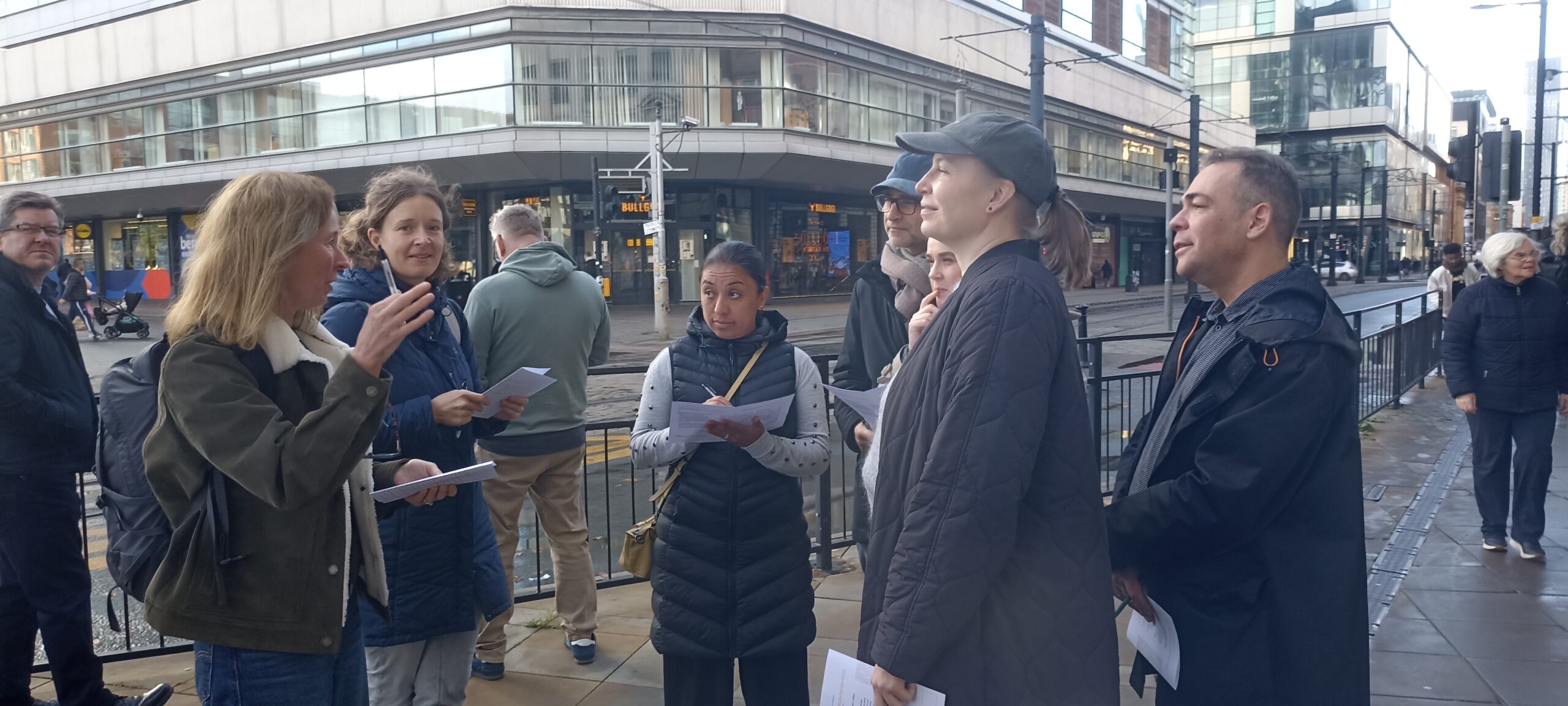
Dr McLean invited participants to experience Manchester through scent – noticing how smells shifted from street to street, doorway to park, café to tram stop. Participants “caught”, “hunted for”, and explored different smells as they walked through the city, before reflecting on and visualising these sensory experiences during a follow-up creative workshop. Findings from the smellwalk will be exhibited at the next IPBA Conference in Lisbon in 2026.
The workshop also connected closely with ongoing research at Manchester Metropolitan University by Dr Chloe Steadman (Senior Lecturer in Marketing), who is exploring new ways of understanding high street atmospheres – the emotional and sensory feel of place – through creative and participatory methods. Together with researcher Loretta Lipworth, Dr Steadman has co-produced six practical guides covering methods such as drawing and mapping, photography, poetry, sensory participation, smellwalks, and soundwalks.
These methods are increasingly relevant for place managers, urban designers, researchers, and community leaders because they help us:
- Understand what gives a place its distinctive atmosphere and identity;
- Move beyond visual analysis to include sound, smell, taste, texture, and emotion;
- Strengthen engagement by encouraging communities to share lived experiences in creative and accessible ways.
Reflecting on the workshop, Dr Steadman said: “It encouraged me to consider a city I’m so familiar with in a new light, as I encountered smells I often neglect as I’m rushing through the city. It helped me to rethink my own use of sensory data collection and communication methods in a fun format.”
Our upcoming Place Methods Workshop on 9th June will continue these conversations around innovative and creative approaches to understanding places, communities, and lived experience.
If you are interested in experimenting with sensory methods – or trying one of the Atmospheric Methods Guides in your own town centre or high street – you can access the guides or contact the Institute of Place Management via ipm@mmu.ac.uk.
(Image: Participants sharing reflections from the Manchester smellwalk during a follow-up workshop.)