
Dr Michael Martin Says We Must Plan and Design Places Differently for Children

Ahead of the Institute of Place Management and Institute for Children’s Futures roundtable on Children’s Rights in Place, Dr Michael Martin from the University of Sheffield argues that we must plan and design places differently if we are serious about creating communities that work for children and young people. Drawing on his research into play, tactical urbanism and neighbourhood design, Michael says that children’s right to play is not a luxury but a fundamental right that should be embedded in planning, place governance and public policy. He challenges us to rethink streets, neighbourhoods and public spaces that have become dominated by cars and parking, and instead create places that enable children to play, move independently, build social connections and actively participate in community life.
Children play everywhere. Yet their right to play and use public spaces – both protected by a UN Convention – are challenged by our prioritisation of cars, traffic and parking.
Play is fundamental to support children’s holistic development across cognitive, emotional, physical and social skills[1]. Likewise, we are acutely aware that the way we configure and design the built environment significantly influences children’s health and wellbeing, for better or worse[2].
Across our cities, children and young people are let down by a built environment that fails to appropriately consider their needs. Over time, places where children commonly used to play, such as streets and local neighbourhoods, have been transformed into car-only spaces where traffic and parking take priority.
In England’s current National Model Design Code for example, a document that sets out national priorities for how we design our cities and communities, parking is referenced over 100 times. By comparison, play is mentioned on less than 30 occasions, and more than 20 instances refer to the provision of formal playground spaces only.
We are getting our priorities wrong – play should be a central feature of how we plan and design our neighbourhoods and streets.
Children need opportunities to play across both formal and informal spaces. Through our recent research[3], we established that children do not have equal access to formal playground spaces. In the largest study of playgrounds in England (almost 34,000), we found stark inequalities in access to play. Children in the most deprived areas needed to travel further to their nearest playground. We can’t rely on dedicated playground spaces as children’s only play provision.
Instead, we should support young people to safely and independently navigate their environment from their immediate doorstep to spaces across their wider neighbourhood – by foot, bike, scooter, rollerblading, skateboarding or similar.
Role of tactical urbanism
Tactical urbanism has a core role to play in how we design and deliver streets that promote children’s playful mobility. Tactical urbanism interventions are a city and/or citizen-led approach to neighbourhood building using short-term, low-cost and scalable interventions. Fantastic best-practice examples of tactical urbanism for children have emerged internationally, particularly since COVID-19, via interventions including open streets, play streets, school streets, pop-up play spaces and play zones.
Organisations such as Playing Out in Bristol are showcasing the emancipatory potential of play streets to bolster children’s right to play, closing streets to cars for a set period of a particular day. Likewise, Barcelona’s Super Block model, which promotes sustainable mobility and new plazas, demonstrates the civic benefits of removing cars and parking for citizens of all ages. Common across these initiatives is the promotion of streets as places for people.
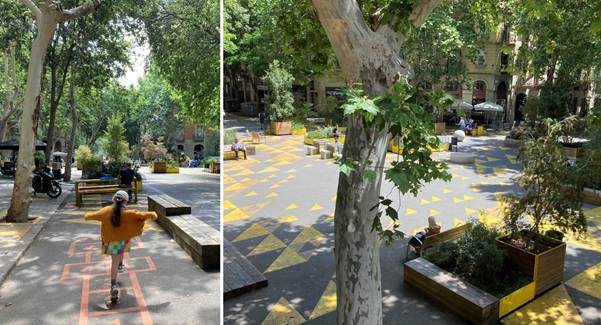
In my research[4], I’ve shown how similar international examples of tactical urbanism can promote children and play in less likely urban spaces. My findings show how play can be planned for and promoted in streets and spaces – that normally marginalise children and play – to support children’s right to play anywhere.
Promoting streets for play
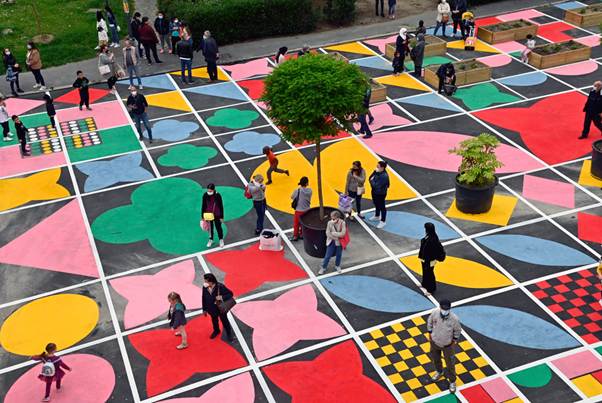
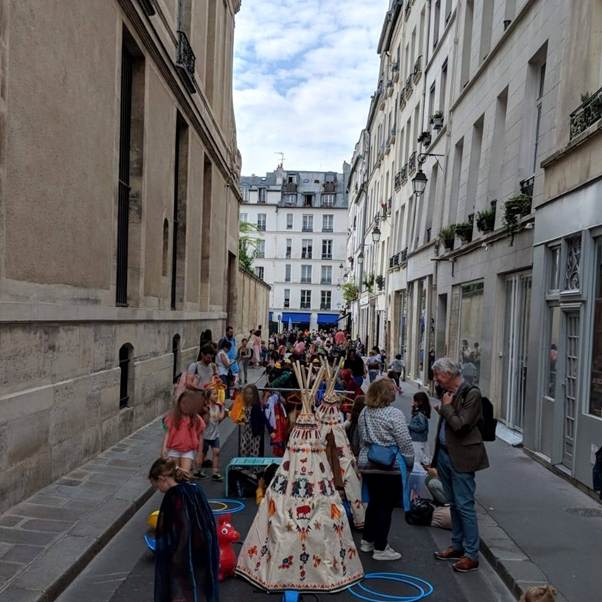
In Sydney, a pop-up pedal park installation with temporary jumps, ramps and a pump track was set up in different car parks for the duration of the winter. In Paris, a play street in the 3rd District of the city created unique play opportunities by closing road traffic on Friday afternoons in autumn and spring. In Milan, through the Piazze Aperte initiative, a community-led design involved creating a colourful gird, planters, growing beds and games in what was once a school car park.
International Best Practice
Milan’s Piazze Aperte (or Open Piazza) is an incredible example of best-practice in the promotion of streets and spaces for people and play at a city-wide level, rather than cars and parking.
By removing cars, traffic and parking, the play spaces I researched allowed children to play freely, play with objects, play pretend, play games with rules, and play physically – the core pillars of play. What’s more they enabled children to develop new connections with their neighbourhood by appropriating urban spaces to promote relaxation and fun. In fact, they bolstered civic access for people of all generations.
In Sydney and Paris car park and street closures fostered a new sense of community. Caregivers, grandparents and residents were able to connect with each other in a whole different setting[5].
Despite the positives, I also found hostility to children’s right to use urban spaces and streets for play. Over time, all projects faced protest and tension. Because of a range of aggressive behaviour from adults – about cars and parking – children’s use of streets and spaces were consistently restricted.
If we want to reduce child death and injury on our roads, we’ve got to get past the politics and over the blame-shifting.
Streets that allow for children’s play can create dynamic neighbourhoods, intergenerational encounters, and meaningful participation in urban spaces – but we’ve got to plan for it.
Planning for play
Recent UK Government initiatives such as recognising play as an eligible spend in the Pride in Place Programme Impact Fund as well as the establishment of the National Playground Fund are welcome – but the scale of the inequalities for play provision that we uncovered – require long-term funding and effective legislative change, particularly in how we plan and design cities, neighbourhoods, streets and spaces to promote play.
In England, we have seen increased recognition of the importance of planning for children and play in the draft National Planning Policy Framework and draft Design and Placemaking Planning Practice Guidance. Both national policy frameworks recognise and accept that we have to plan for play across a spectrum of places and spaces from door-steps to streets as well as more formal play space provisions.
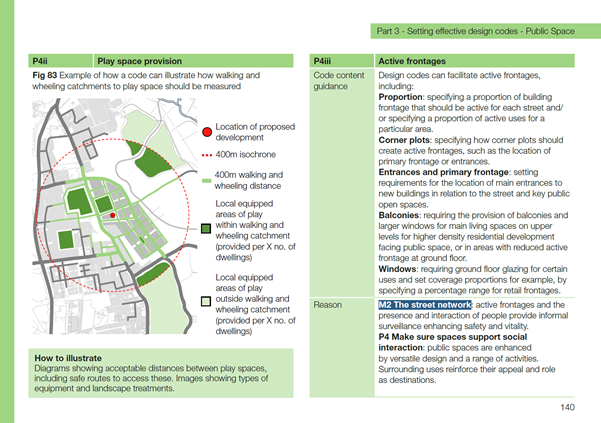
While proposed planning policy changes are a positive step, what is needed to ensure opportunities for children and young people to play are approaches that embed these stakeholders as core, fundamental considerations in planning.
Scotland and Wales have achieved this, with national strategies for play and a statutory requirement for play sufficiency assessments by local authorities to assess, secure, enhance and protect sufficient play opportunities for children.
England still lags behind; we need a National Play Strategy and a statutory Play Sufficiency duty to be embedded in law. Working with Play England, we have been lobbying government to embed play sufficiency into local plans and planning decisions.
If we want to achieve positive change, we must accept play is not a luxury, it’s a right – planning has a core role to make that happen!
[1] Martin, M., Jelic, A. and Doktor Olsen Tvedebrink, T. (2023) Children’s opportunities for play in the built environment, Children’s Geographies
[2] Black, P. Martin, M., Phillips, R. and Sonbli T. (2025) Applied Urban Design: A Contextually Responsive Approach, Routledge: New York.
[3] Brindley, P. and Martin, M. (2025) We mapped 34,000 children’s playgrounds and revealed inequality across England, THE INDEPENDENT
[4] Martin (2025a) Pandemic play spaces: Interim innovations, creative placemaking and lasting change for children in cities, Journal of Urban Design
[5] Martin (2025b) How to give children the freedom to play all across the city – not just in playgrounds, THE CONVERSATION